- Acronimo
- TRANSFER
- Area di ricerca
- Earth science
- Tematica specifica di ricerca
- biogeochemical cycle of impurities and contaminants
- Regione di interesse
- Svalbard, Ny Alesund, Gruvebadet
- PI
- Andrea Spolaor
- Istituzione PI
- CNR-Istituto di Scienze Polar
- Sito web istituzionale
- https://www.isp.cnr.it/index.php/it/
- Altre Istituzioni e soggetti coinvolti
- Dipartimento di Chimica, Biologia e Biotecnologie, Università degli Studi di Perugia; Chemistry Department “Ugo Schiff” (DICUS), University of Florence; Università degli Studi di Torino; Institute of Atmospheric Sciences and Climate (CNR-ISAC)
- Consistenza del team ricerca
- Il team di ricerca comprende partecipanti da enti di ricerca e Università Italiane rispettando i criteri di gender balance
- Stato progetto
- In corso
- Il progetto
The shrinkage of the Arctic Sea ice cover and glaciers mass, the changes in oceanic circulation and atmospheric transport due to the phenomena of the Arctic amplification can enhance the spread and deposition of particle-bound pollutants, from aerosol to snow/ice to their further release in the marine environment. TRANSFER aims to improve our knowledge on the short and long-term effects of the Arctic amplification on the pollutant dynamics in the Svalbard environment, through an integrated approach.
- Immagini
-
-
-
- Motivazione, importanza della ricerca
The phenomenon of the Arctic climatic amplification is deeply modifying the Arctic environment in all its aspects. The temperature is increasing with a rate of 1.3 °C per decade, the duration of the snow coverage has decreased by about 30 days in the last few decades, almost all Svalbard glaciers have a negative mass balance even though the amount of precipitation has doubled, the cyclonic events during the winter have increased and the thickness of the permafrost active layer has changed from 1.5 m to almost 2 m. One of the main aspects of the Arctic mplification is the increase in the transport of mid-latitude warmer and more humid air masses to the Arctic. These air masses are able to carry a greater amount of particles and gases emitted at mid-latitudes into the Svalbard environment with possibly direct consequences for the entire ecosystem (aerial, terrestrial and marine) of the archipelago. To unravel the complex interconnection among transport, deposition, and the following release of pollutants in the Svalbard environment, a multi-scale approach is now fundamental. The atmosphere is the major and fastest carrier of pollutants into the Svalbard environment, thus studying its composition and the on-going changes is essential to understanding the change driven by the Arctic amplification. Being at the interface between the atmosphere, the ground and the coastal marine environment, the snow cover is a unique environment whose composition and physical properties strictly depend on the atmospheric characteristics. During the winter season the snow can absorb, storing within it, atmospheric pollutants releasing them as a single pulse during the melting season. In addition to the particles and compounds that can be preserved in the annual snowpack, black carbon (BC) is a specific type of particle composed of light absorbing carbonaceous material that can accelerate snow fusion. The evaluation of BC, and in general light absorbing particles, in the atmosphere and in the snow is fundamental since it can have a direct effect on the snow and glacier melting, favouring surface snow and ice energy absorption. During the melting season all the chemicals (natural and anthropogenic) can be released into the ground and later into the coastal marine water, with a possible direct effect on the Svalbard terrestrial and marine fauna. In addition to the annual snow melting, a wide range of contaminants may be potentially released by local glacier retreat (mass reduction) and by permafrost thawing. When considering how climate change will influence the emission, transport, fate and exposure pathways of contaminants in marine environments, it is important to distinguish between primary and secondary emissions. For new persistent organic pollutants (POPs’, including endocrine disrupting -EDC and emerging -EC compounds) any changes of primary emission will be a result of changed human behaviour (e.g. by legislation). The release from existing stocks (e.g. melt of glaciers and/or snow) is a secondary or legacy input source for ‘old POPs’ (such as PAHs and PCBs) and results in a redistribution of contamination. Nevertheless, a knowledge gap persists on the effects of climatic change on
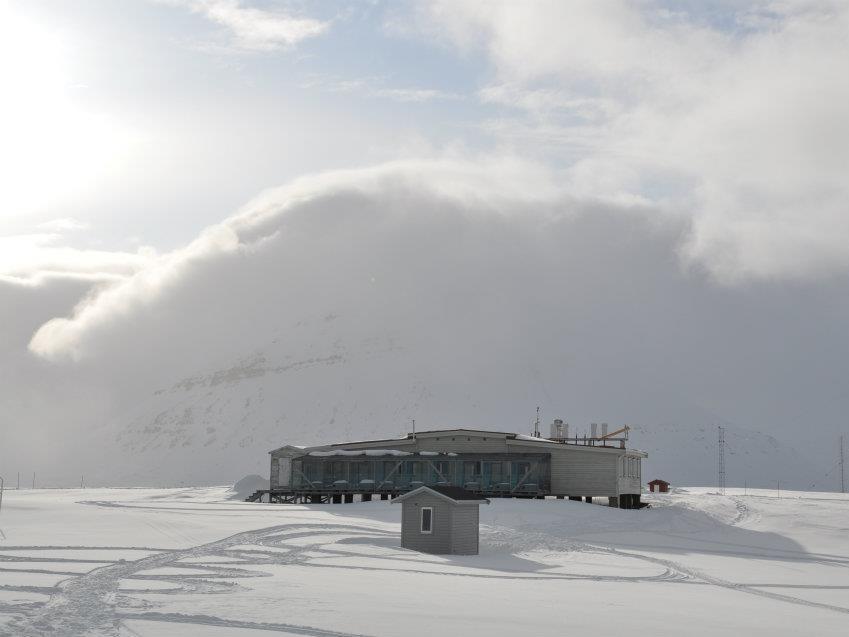
contamination behaviour in polar ecosystems. The TRANSFER project brings together experts from different scientific fields and, based on a long track record of monitoring activities, aims to study the cycle of pollutants in the Svalbard archipelago: from atmospheric transport to the release into the ground and into the coastal marine environment (see the project conceptual illustration in the supplementary). The final goal is to understand the consequences of the Arctic amplification on the environmental cycle of natural and anthropogenic compounds in the Svalbard archipelago. The approach proposed by TRANSFER is unique since it requires the interoperability of several research teams and their instrumentation. Snow, atmosphere and marine chemical characterization are well explored by the Italian scientific community but it is now necessary, for addressing the question posed in TRANSFER, to adopt a multidisciplinary and coordinated action. TRANSFER will improve the current technological instrumentation available at the Gruvebadet Atmospheric Laboratory (GAL) by acquiring up-to-date aerosol samplers and automatic aerosol analysers and by improving the laboratory capability at the Dirigible Italian Station (DI) necessary for in-situ sample processing, essential to investigating the complex and new environmental interactions.
- Obiettivi della proposta
TRANSFER will aim to answer two specific scientific questions: 1) which is (are) the environmental process(es)
causing the presence of anthropogenic pollutants in the Svalbard environment? 2) Is the Arctic amplification having a direct impact on their transport, storage, and recirculation in this fragile ecosystem? TRANSFER is unique in its
structure with the aim of harmonizing monitoring activities led by the Italian research institutes with long track
records in monitoring programs in the Polar Regions. The final goal is to evaluate the pollutant and aerosol cycles in
the Svalbard environment and the possible consequences caused by the Arctic amplification on their circulation and
environmental fate. The project can have a great impact on both the scientific community involved in TRANSFER
(maximizing the integrated use of the data), and on the attraction of international scientific groups working on this
topic. TRANSFER also aims to bring the Italian research community to a central role at an international level in
studies of aerosol, snow and seawater. Such important goals can only be achieved through the improvement and
renewal of current instruments and laboratory infrastructures available to the scientific community to date. This
technological improvement will create a primary research group that can strongly enhance the knowledge on sources, transport and fate of pollutants on the fragile Svalbard ecosystem, trying to disentangle the role and impact of the Arctic amplification.
- Attività svolta e risultati raggiunti
Le attività si sono focalizzate nel ricercare ed ottenere i preventivi per gli strumenti da acquisire ed iniziare la procedura di acquisto
- Prodotti
Nessun prodotto attualmente disponibile